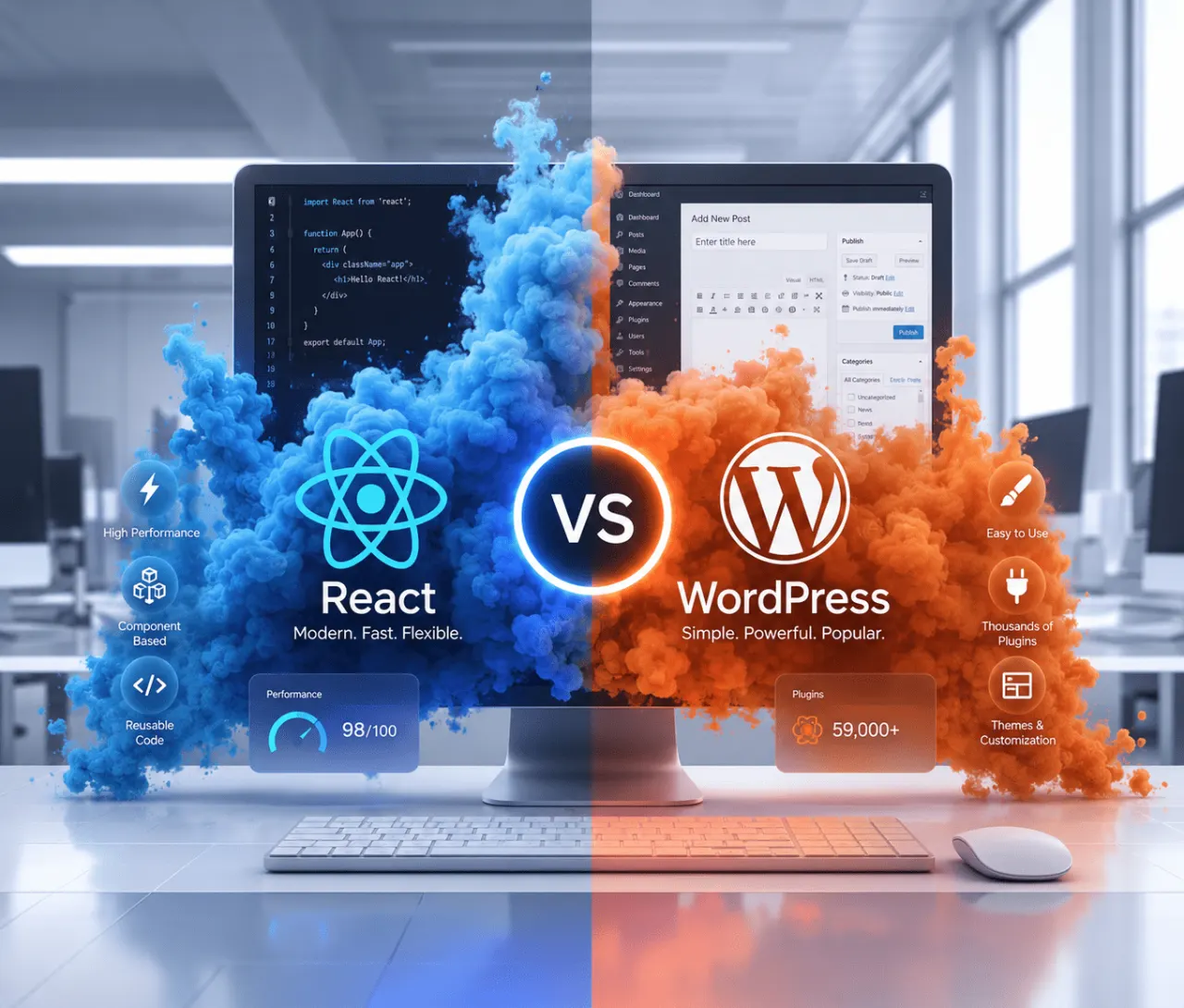
Choosing between
React and WordPress is one of the most common questions we hear from businesses in Saudi Arabia. Both power millions of websites, both are mature and battle-tested — and both can be the wrong choice if they don’t match your goals. As a
software development company in Jeddah that builds with both technologies every week, here’s our honest, practical comparison to help you decide.
React vs WordPress: The Short Answer
WordPress is a
content management system (CMS) — ideal when your website is mainly about publishing content: company sites, blogs, news portals, and standard business pages. React is a
JavaScript library for building user interfaces — ideal when your website behaves like an application: dashboards, booking systems, marketplaces, and any product where users interact constantly with dynamic data.
In other words: if your site is something people
read, WordPress usually wins. If it’s something people
use, React usually wins. Let’s break down why.
What Is WordPress?
WordPress is the world’s most popular CMS, powering roughly 40% of all websites. It gives you a ready-made admin panel, thousands of themes and plugins, and a publishing workflow your marketing team can manage without touching code. For most company websites and content-driven projects, our
web development team in Jeddah can launch a polished WordPress site quickly and affordably.
Advantages of WordPress
WordPress shines in speed to launch and ease of management. Your team can edit pages, publish blog posts, and update products without a developer. The plugin ecosystem covers almost everything — SEO, forms, e-commerce with WooCommerce, multilingual sites (essential for Arabic/English businesses in Saudi Arabia), and more. Hosting is cheap, developers are easy to find, and the total cost of ownership for a standard site is low.
Limitations of WordPress
The flexibility comes at a price. Plugin-heavy sites can become slow and harder to secure, and highly custom functionality often means fighting the platform instead of working with it. When a project outgrows what themes and plugins can do — complex user accounts, real-time features, custom workflows — WordPress starts to strain. That’s typically the point where clients come to us for
custom software development instead.
What Is React?
React is a JavaScript library created by Meta for building fast, interactive user interfaces. It doesn’t come with an admin panel or ready-made themes — instead, it gives developers complete control to build exactly the experience your product needs. React powers the front end of applications like Facebook, Airbnb, and Netflix, and it’s the foundation of many of the
projects in our portfolio, from booking platforms to school management systems.
Advantages of React
React applications feel instant. Pages update without reloading, interfaces respond immediately, and complex features — live search, dashboards, real-time notifications — are natural to build. React also pairs beautifully with mobile: with React Native, much of your web code can be reused for iOS and Android apps, which is why our
mobile app development projects often share technology with their web counterparts. For products that need to scale to thousands of users with custom logic, React is the stronger foundation.
Limitations of React
React requires professional developers — there’s no dashboard your marketing team can use out of the box, and content changes go through a development workflow unless you pair React with a headless CMS. Build time and initial cost are higher than a WordPress site. And SEO needs deliberate engineering: because React renders in the browser, you need server-side rendering or static generation (usually via Next.js) to rank well in Google.
React vs WordPress: Head-to-Head Comparison
Cost and Time to Launch
WordPress wins for standard websites: a professional business site can go live in weeks at a fraction of the cost. React projects take longer and cost more upfront — but for application-style products, that investment buys you performance and flexibility WordPress can’t match. Trying to force an app into WordPress plugins often costs more in the long run than building it properly.
Performance and User Experience
A well-optimized WordPress site is perfectly fast for content pages. But for interactive experiences — filtering products, live booking calendars, multi-step workflows — React delivers a smoother, app-like feel that WordPress simply can’t replicate. If user experience is your competitive edge, React is worth it.
SEO
WordPress has the edge for content SEO out of the box: clean URLs, easy metadata, mature SEO plugins, and a blogging engine Google loves. React can rank just as well, but only when built with server-side rendering by developers who understand technical SEO. This is why we often recommend WordPress for marketing sites even for clients whose main product runs on React.
Security and Maintenance
WordPress’s popularity makes it a target — outdated plugins are the most common attack vector, so ongoing updates are essential. React applications have a smaller attack surface but depend on the quality of the engineering behind them. Either way, maintenance isn’t optional; it’s part of owning a serious web presence.
Scalability
For growing traffic on content sites, WordPress scales fine with good hosting. For growing
functionality — more features, more user types, more integrations — React with a modern backend and
cloud infrastructure scales far more gracefully.
Can You Use Both Together?
Yes — and it’s often the smartest choice. A popular modern architecture is
headless WordPress: WordPress manages your content behind the scenes, while a React front end delivers a fast, app-like experience to visitors. You keep the editing convenience your team loves and gain the performance and flexibility of React. Another common pattern we build is a WordPress marketing site paired with a React web application for the product itself — each tool doing what it does best. If you’re weighing this kind of hybrid, our team can advise on the right architecture as part of our
software development services.
Which One Should Your Business Choose?
Choose
WordPress if you need a company website, blog, or standard e-commerce store, your team wants to manage content themselves, and speed to launch matters more than custom functionality.
Choose
React if you’re building a web application — a booking system, portal, dashboard, marketplace, or SaaS product — where user interaction, performance, and custom features define the experience.
Choose
both (headless) if you want WordPress’s easy content management with React’s speed and interactivity, and your budget supports a more sophisticated build.
Still Not Sure? Let’s Talk
The honest truth: the right technology depends on your specific goals, budget, and growth plans — not on trends. At Whetstonez, we’ve been building web and mobile solutions for Saudi businesses
since 2012, and we’ll recommend the stack that serves your business, not the one that’s fashionable.
Get a free consultation and we’ll help you choose — and build — the right foundation for your project.