If your ordering system runs abroad and most customers are in Saudi Arabia, a local cloud region gives you a reason to recheck your options. Start with one question: what would improve if you moved? A clear answer might be faster checkout, a customer contract that calls for local hosting, or an easier way to recover from a server failure. Each reason points to a different first move.
What has changed in Saudi Arabia?
- Google Cloud offers its Dammam region (
me-central2). Google documents purchasing and access through CNTXT for customers with a Saudi billing address. Google Cloud region access. - Microsoft announced November 2026 availability for Azure Saudi Arabia East. Confirm that your subscription can deploy the services and tiers you need. Microsoft announcement.
- AWS says its first Saudi region is on track to launch in December 2026. Treat the date as a planning milestone and confirm availability before scheduling a production cutover. AWS announcement.
Make the decision one application at a time
- Move a workload when you have a documented reason, the target region supports its dependencies, and you can demonstrate recovery in a test.
- Run a pilot first when your goal is better performance. Measure key actions from Saudi networks before and after, such as the time it takes to load an order or finish checkout. A local app can still wait on an overseas database or payment integration.
- Keep the current setup for now when a critical service is unavailable in the target region, the cost is unclear, or a failed migration would leave you without a tested way back.
Trace the copies of your data
Draw a simple map that includes the production database, snapshots, backups, logs, exported reports and external tools. Ask where each copy is stored, where it is processed and who can access it. Check your customer contracts and any sector requirements alongside Saudi Arabia’s Personal Data Protection Law. Have the team responsible for privacy review any transfers of personal data outside the Kingdom. SDAIA implementing and transfer regulations.
Check the exact database version, backup features and service quotas in the target region. Compare the ongoing bill for compute, storage, data transfer and support. Add the temporary cost of running both environments during the move.
A three-phase migration plan
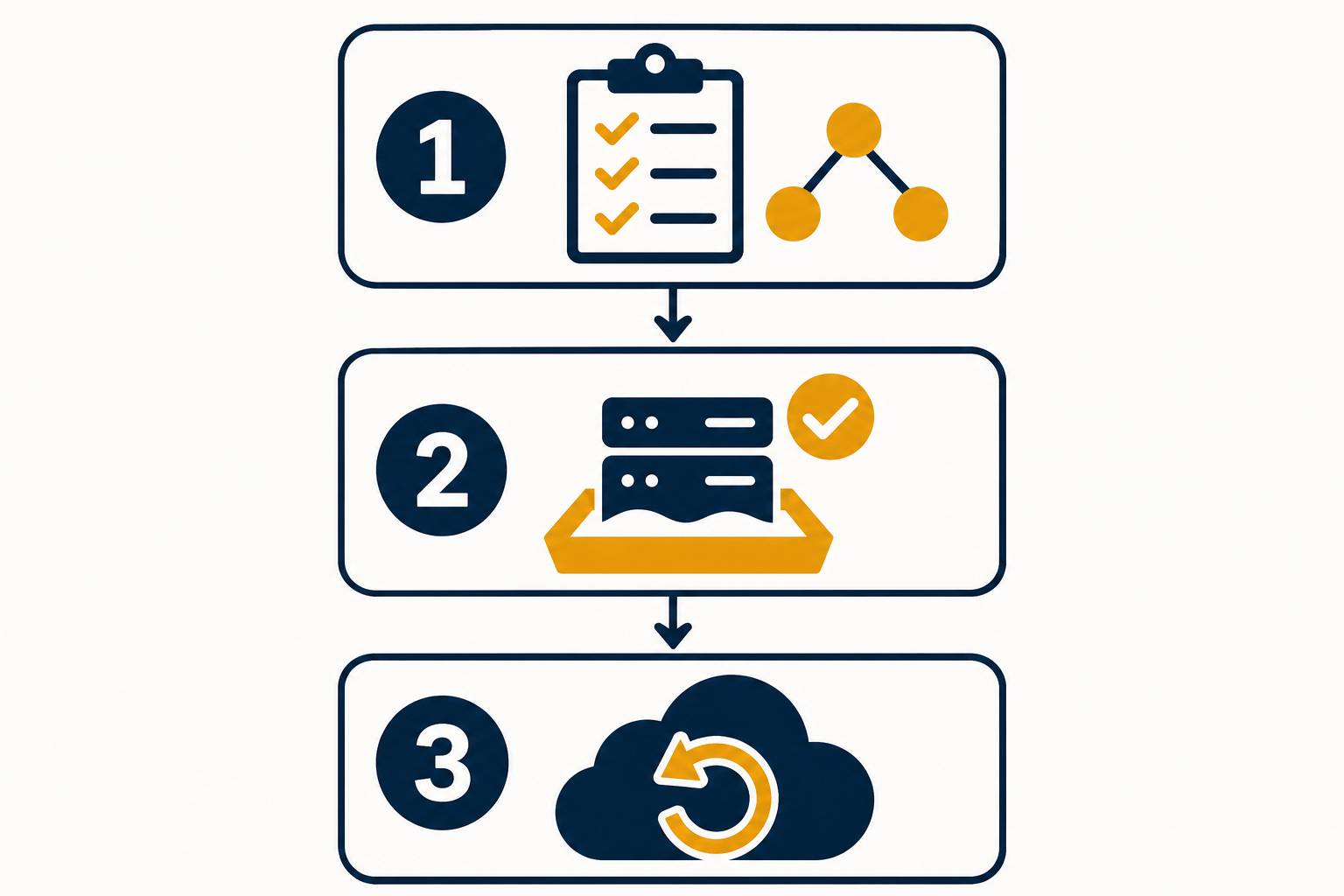
- Map the application. List what it calls and what calls it, including scheduled jobs and outside services. Agree how much downtime and data loss the business can tolerate.
- Test one low-risk workload. A distributor could start with its read-only stock lookup using test data. Measure response time from branches, check access controls and restore a backup into a separate environment. Record how long the restore takes.
- Move production in waves. Rehearse the cutover and define the rollback trigger. For an order system, decide how to reconcile orders accepted after the switch if you have to go back. Keep the previous environment available until the new setup passes the agreed checks.
What should you do this week?
Pick one application. Name the business outcome you want, list the services the app depends on, and record where its backups go today. That gives you enough information to decide whether to test a Saudi cloud region and what the pilot needs to prove.
Whetstonez can help assess your setup, choose a pilot and plan the migration in phases. Explore Whetstonez cloud migration services.