Every growing business eventually reaches the same crossroads: should you buy ready-made software, or build your own? The
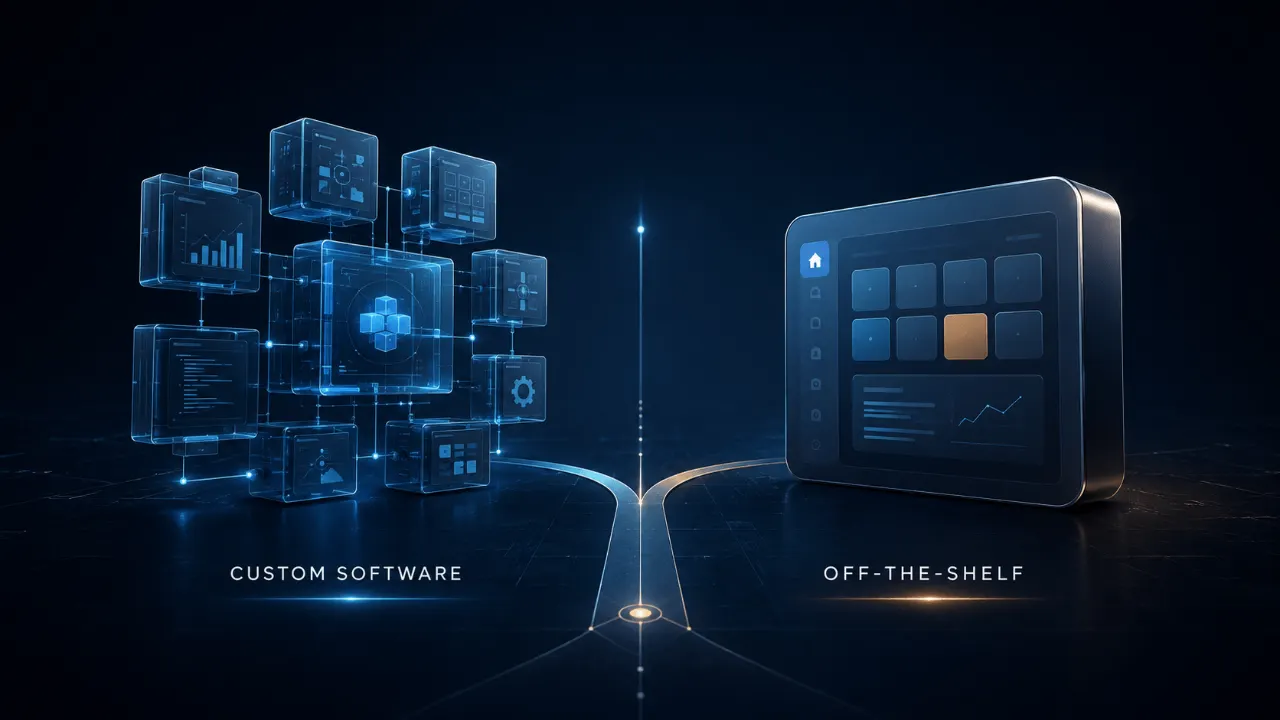
custom software vs off-the-shelf software decision affects your budget, your daily operations, and how well your business can scale for years to come. Choose wrong, and you either overpay for features you’ll never use or outgrow a tool that holds you back. This guide breaks down both options in plain language — the pros, the cons, the real costs, and how to decide which one fits your business.
What is off-the-shelf software?
Off-the-shelf software is a ready-made product built for the general market and sold to many customers. Think of popular tools like accounting apps, CRMs, or project management platforms. You subscribe or buy a license, set it up, and start using it right away. It’s designed to solve common problems that most businesses share, which makes it fast to adopt and relatively affordable to start with.
What is custom software?
Custom software is built specifically for your business, around your exact processes, goals, and workflows. Instead of adapting your operations to fit a product, the software is designed to fit you. It can do exactly what you need — no more, no less — and grow with you over time. Because it’s developed from the ground up, it takes more time and investment upfront, but it delivers a solution that’s truly your own. This is the kind of solution a
custom software development partner creates for you.
Custom software vs off-the-shelf software: a quick comparison
| Factor |
Off-the-Shelf Software |
Custom Software |
| Upfront cost |
Low — subscription or license |
Higher — built to order |
| Setup speed |
Fast — ready to use |
Slower — needs development |
| Fit to your needs |
Generic — you adapt to it |
Exact — built around you |
| Scalability |
Limited by the product |
Grows with your business |
| Ownership |
You rent access |
You own the software |
| Long-term cost |
Ongoing fees per user, forever |
One-time build + maintenance |
| Competitive edge |
Same tools as competitors |
Unique advantage |
Pros and cons of off-the-shelf software
Ready-made software is popular for good reasons, but it comes with trade-offs.
On the plus side, it’s affordable to start, quick to deploy, and usually well-supported with regular updates, tutorials, and a large user community. For common needs — email, accounting, basic CRM — it’s often the smart, sensible choice.
The downsides show up as you grow. You’re limited to the features the vendor offers, so you may end up paying for tools you don’t use while missing the ones you need. You often have to change your workflow to match the software rather than the other way around. Per-user subscription fees add up quickly as your team expands, and you have little control over pricing changes, feature removals, or the product being discontinued.
Pros and cons of custom software
Custom software flips the equation: more investment upfront, but a solution built entirely around your business.
The advantages are significant. It fits your processes perfectly, includes exactly the features you need, and scales as you grow. You own it, so there are no per-user fees piling up over the years, and it can give you a real competitive edge that off-the-shelf tools — used by everyone, including your rivals — simply can’t. It also integrates cleanly with your other systems through
API development and integration, so everything works together smoothly.
The trade-offs are the higher upfront cost and the time it takes to build. It’s an investment, and it requires a reliable development partner. But for the right use case, that investment pays for itself many times over.
Cost: which one is cheaper?
This is the question most businesses care about most, and the honest answer is: it depends on the timeframe. Off-the-shelf software is cheaper to start — you might pay a modest monthly fee per user. Custom software costs more upfront because it’s built from scratch. But over several years, the maths often shifts. Subscription fees multiply as your team grows and never stop, while custom software is largely a one-time investment plus maintenance. For a small team with simple needs, off-the-shelf usually wins on cost. For a growing business with specific requirements or many users, custom software frequently becomes the more economical choice over time.
When to choose off-the-shelf software
Ready-made software is the right call in plenty of situations. Choose it when your needs are common and well-served by existing products, when you need a solution up and running immediately, when your budget is tight and you’re just getting started, or when the task isn’t central to what makes your business unique. There’s no reason to build a custom email client or a custom word processor — excellent ones already exist. Use off-the-shelf tools for the standard parts of your operation and save your investment for what really sets you apart.
When to choose custom software
Custom software becomes the smart choice when your business has unique processes that no existing product handles well, when you’re paying for multiple tools that still don’t quite fit, or when per-user fees are becoming painful as you scale. It’s also the right move when the software is core to your competitive advantage, when you need deep integration with your existing systems, or when you simply want full ownership and control. If you’ve ever thought “I wish our software could just do X,” that’s often the sign that a tailored solution — sometimes starting with a lean
MVP or product engineering approach — will serve you far better than another subscription.
Is there a middle ground?
Yes — and many businesses land here. You don’t have to choose one approach for everything. A common, cost-effective strategy is to use off-the-shelf tools for standard functions (like email or accounting) while building custom software for the parts that make your business distinctive. Another option is to customize or extend existing platforms, or connect several tools together with custom integrations so they work as one system. A good technology partner can also help you weigh options through
IT consulting and digital transformation guidance, so you invest only where it truly pays off.
How to make the right decision
Start with your goals, not the technology. Ask yourself a few honest questions: How unique are our processes? How many users will need this, and how fast are we growing? What’s our budget now, and what’s the cost over three to five years? How important is this software to our competitive edge? If your needs are simple and common, off-the-shelf is likely the practical choice. If they’re specific, central to your business, or scaling fast, custom software will usually deliver more value in the long run. When in doubt, a short consultation with an experienced
software and technology partner can help you map the numbers and choose with confidence. For a broader view of the trade-offs, resources like
IBM’s overview of custom software development are a useful reference.
Frequently asked questions
Is custom software more expensive than off-the-shelf?
Upfront, yes. But over several years, custom software can be cheaper because you avoid ongoing per-user subscription fees and don’t pay for features you don’t use. The best choice depends on your team size, needs, and growth plans.
How long does it take to build custom software?
It varies with complexity. A focused solution or MVP can take a few weeks to a couple of months, while a large, feature-rich system may take several months. Starting with a well-defined first version keeps timelines and costs under control.
Can custom software integrate with the tools I already use?
Yes. A key benefit of custom software is smooth integration with your existing tools — your CRM, accounting, or other systems — through APIs, so everything works together instead of in silos.
Can I start with off-the-shelf and switch to custom later?
Absolutely, and many businesses do. It’s common to begin with ready-made tools, learn where they fall short, and then invest in custom software for the areas that matter most as you grow.
The bottom line
There’s no universal winner in the
custom software vs off-the-shelf software debate — only the right fit for your situation. Off-the-shelf software is fast, affordable, and perfect for common needs. Custom software costs more upfront but delivers an exact fit, full ownership, and a long-term competitive edge. Weigh your needs, your budget, and your growth plans, and remember you can mix both. Make the choice that serves your business three years from now, not just today.
Not sure which path fits your business? Contact Whetstonez Technologies for a free consultation and honest advice on whether to buy, build, or blend.